Your Child Says They Revised. But Do You Actually Know What They Know?

"Have you revised?" "Yes." "What did you revise?" Silence. If this is your house every evening, you're not alone. 85% of UK parents can't answer a standard GCSE maths question — so how are we supposed to know if our children are actually prepared?
The Invisible Problem: Why "I Revised" Means Nothing

Your child sits at their desk for an hour. They open a textbook. Maybe they watch a YouTube video. They come downstairs and say, "I revised."
But what did they revise? Which topics? Were they the ones they actually need to work on? Did they understand the material — or just look at it?
This is the invisible problem facing most parents of GCSE students. You know your child needs to revise. They might even be willing to do it. But you have zero visibility into what's actually happening — which topics are covered, which are being avoided, and where the real gaps are hiding.
And here's the part that makes it worse: most students naturally gravitate towards topics they already understand. It feels productive. But the topics they skip — the ones that feel confusing or uncomfortable — are almost always the ones costing them marks on exam day.
Without knowing what your child doesn't know, you're both guessing. And guesswork doesn't move grades.
Why You Can't Check (Even If You Wanted To)
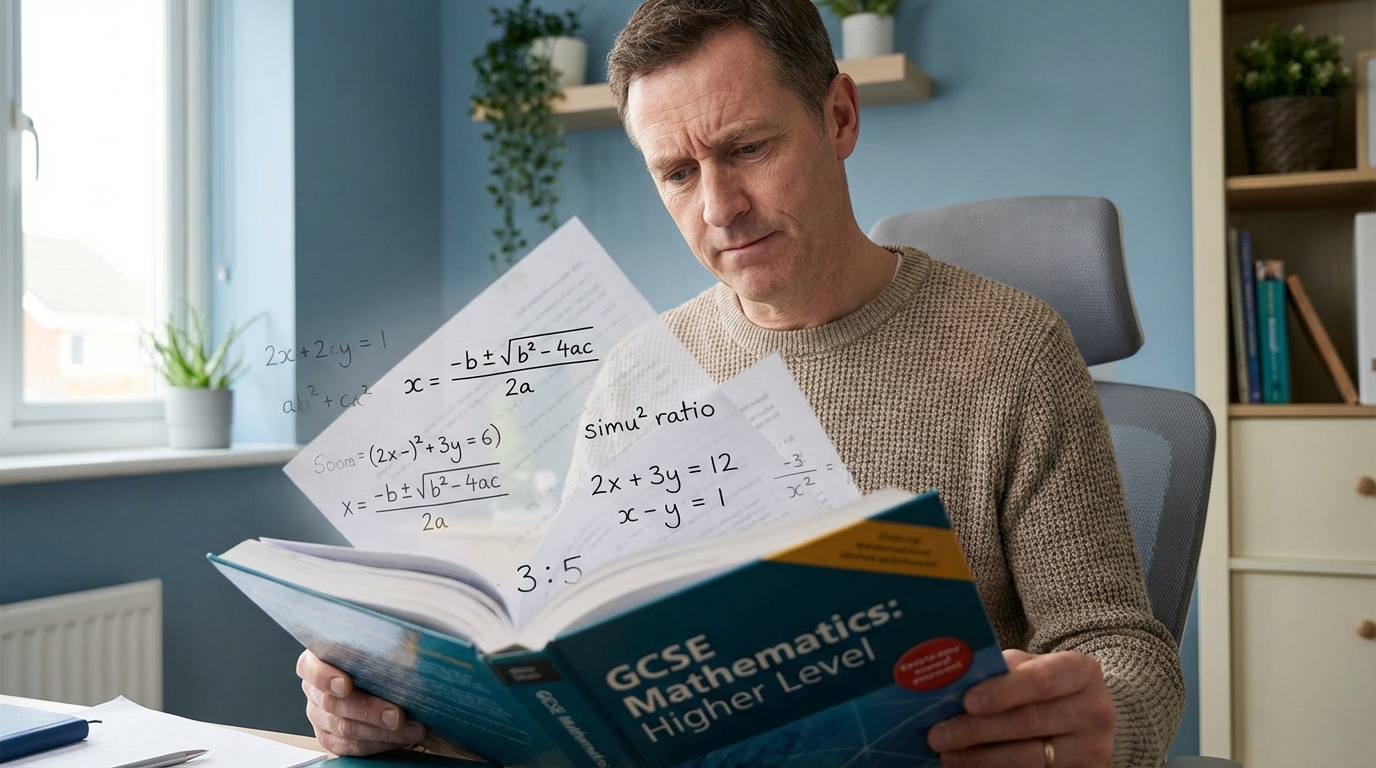
Let's be honest about something most parents feel but rarely say out loud: GCSE maths has changed beyond recognition.
The curriculum was completely overhauled in 2016. It's harder, broader, and uses methods most of us never learned. A survey by SaveMyExams found that 85% of UK parents cannot answer a standard GCSE maths question correctly. A third of parents believe they would fail today's exams entirely.
So when your child asks for help with ratio, or simultaneous equations, or quadratics with fractional coefficients — and you can't help — the guilt hits. You feel like you should be able to do something. But the curriculum has moved past what you studied, and trying to help using "the old way" often causes more friction than progress.
"You don't need to understand GCSE maths. You need to see what's going wrong. Those are two very different things."
This is the shift that changes everything: your job as a parent isn't to teach the content. It's to have visibility — to see where your child is strong, where they're struggling, and whether the revision they're doing is actually working.
What a 15-Minute Diagnostic Actually Reveals
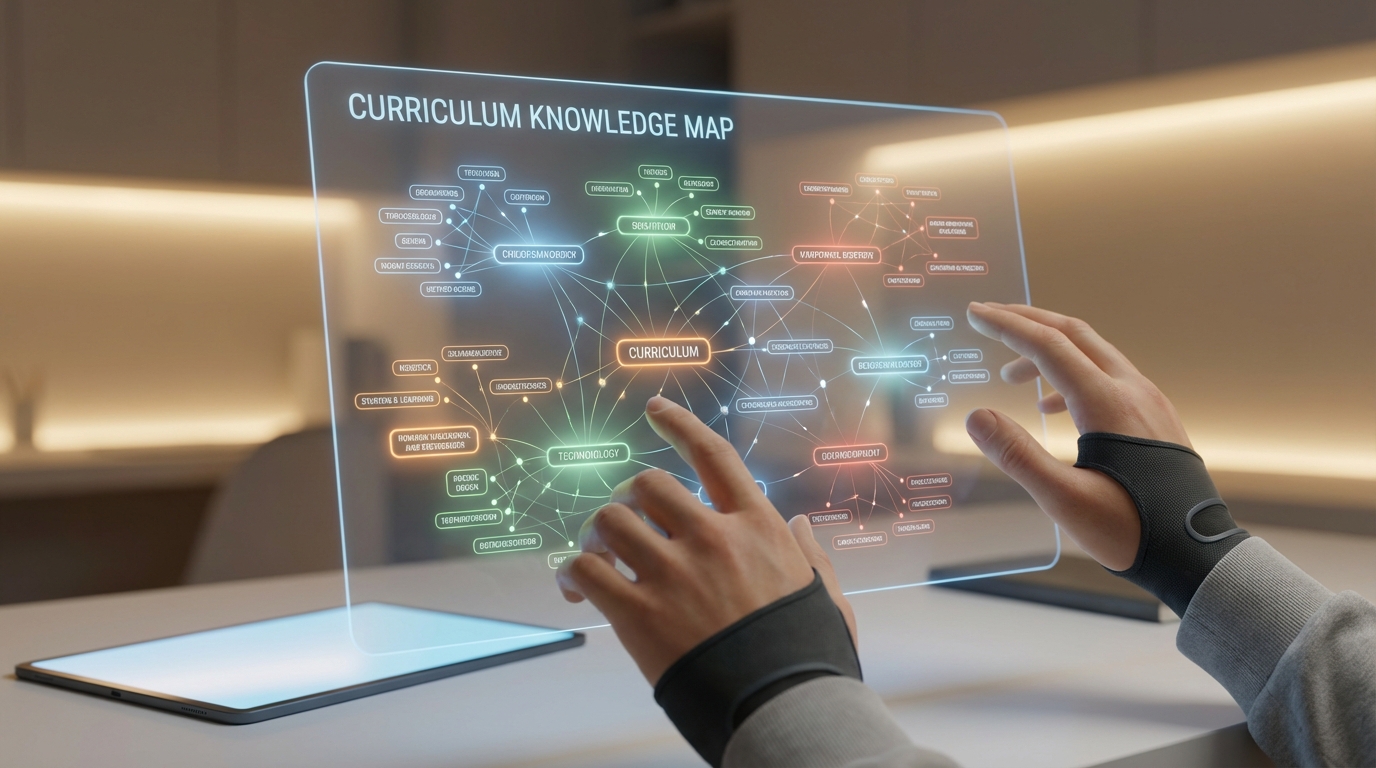
Traditional revision relies on your child deciding what to study. That means they choose topics they're comfortable with, skip the ones they find hard, and hope for the best.
An AI-powered diagnostic flips this completely. In about 15 minutes, it maps your child's understanding across the entire GCSE maths curriculum — every topic, every subtopic — and shows you exactly where the gaps are [1].
Not "your child is weak at algebra." That's too vague to act on. Instead: "Your child understands basic algebra but struggles with quadratic equations involving negative coefficients — and this is affecting their ability to answer 12% of typical exam questions."
That level of detail changes everything. It means revision becomes targeted rather than random. By analysing performance patterns, response times, and the specific types of errors your child makes, AI identifies the root cause of each struggle — not just the symptom [2].
For example, a child who consistently gets ratio questions wrong might not have a ratio problem at all — they might have a fractions gap from Year 8 that's been silently undermining everything built on top of it. A good diagnostic finds that buried root cause.
Once the gaps are mapped, the platform builds a personalised daily plan — targeting the highest-impact weak areas first, adapting as your child improves, and making sure every revision session counts [4].
Why AI Works Particularly Well for Maths

If you're sceptical about AI in education — good. You should be. Not all subjects benefit equally, and no technology is a magic solution.
But maths has a distinct advantage. A peer-reviewed study published in Computers and Education: Artificial Intelligence found that AI achieves its highest accuracy in STEM subjects, precisely because maths has clear right-and-wrong answers with minimal grading subjectivity [3]. In subjects like English or History, where marks depend on interpretation and argument quality, AI has more room for error. In maths, 2x + 3 = 7 has one answer, and the AI knows whether your child got there — and where they went wrong if they didn't.
This means that for GCSE maths specifically, AI diagnostic tools are operating in the domain where they're most reliable. The step-by-step nature of mathematical problem-solving is ideally suited to AI analysis — it can trace exactly where in a multi-step calculation your child's understanding breaks down [2].
That said, it's worth being clear: AI is a tool that supports learning — it doesn't replace good teaching, and it works best when combined with official past papers and exam-board-specific resources [2]. But as a diagnostic and revision-targeting layer? For maths, it's exceptionally well suited.
The Parent Dashboard: See Everything Without Asking
Here's where it gets personal. Finding your child's gaps is step one. But what parents tell us they need most isn't a one-off report — it's ongoing visibility. You want to know: is my child actually revising? Are they improving? Should I be worried?
That's exactly what Edmoti's Parent Intelligence Hub was built for. From your phone, you can see:
- A Daily Briefing — what your child studied today, how they performed, and what's coming next
- A Readiness Score (0–100) — a clear measure of how prepared they are across the whole curriculum, updated in real time
- Topic-by-Topic Mastery — colour-coded from Emerging to Exam Ready, across all seven GCSE maths strands
- Risk Alerts — early warnings when a topic starts declining or engagement drops
- Trajectory Graphs — is your child's understanding trending up, flat, or slipping?
The effect on the household dynamic is immediate. You no longer need to ask "have you revised?" — you can see. Your child no longer needs to defend themselves — the data speaks for them. The nightly argument is replaced by a shared understanding of where things stand [4].
"The best revision system is one where you never have to ask 'have you revised?' again."
What You Can Do Right Now

If you've read this far, you're probably the kind of parent who cares deeply but feels stuck. You want to help, but you can't see the problem clearly enough to know where to start.
Here's a simple starting point:
Step 1: Find the gaps. Edmoti's Calibration Diagnostic takes about 15 minutes. Your child answers questions across the full GCSE maths curriculum, and the AI maps exactly where they're strong and where the gaps are hiding. It's free and requires no card.
Step 2: Get the plan. Based on the diagnostic results, Edmoti builds a personalised daily revision plan — targeting the highest-impact weak areas first. Your child gets a clear, manageable 20-minute daily mission. No more "what should I revise?"
Step 3: See the progress. Open the Parent Dashboard and watch the Readiness Score move. See which topics are improving, which need more work, and whether your child is on track — all without asking a single question.
You don't need to understand GCSE maths. You don't need to teach it. You just need to see what's happening — and now, for the first time, you can.
Frequently Asked Questions
How do I find out which GCSE maths topics my child is struggling with?
The most effective way is a diagnostic assessment. Platforms like Edmoti run a 15-minute calibration test that maps your child's understanding across every GCSE maths topic. Instead of vague results like "needs to improve in algebra," you get specific insights such as "struggles with ratio expressed as fractions" — so you know exactly where to focus [4].
Can I help my child with GCSE maths if I don't understand it myself?
Yes — and you don't need to. The GCSE maths curriculum was overhauled in 2016, and most parents find it significantly harder than what they studied. Your role isn't to teach the content. It's to provide support and visibility. A Parent Dashboard lets you see exactly what your child is working on, how they're performing, and where they need help — without having to understand the maths yourself.
How reliable is AI for GCSE maths compared to other subjects?
Research published in Computers and Education: Artificial Intelligence found that AI performs most reliably in STEM subjects like maths, because answers are objective and grading subjectivity is minimal [3]. This makes AI-powered maths diagnostics particularly trustworthy for identifying gaps and tracking progress.
Is my child's data safe on an AI revision platform?
Reputable platforms are GDPR-compliant, use data solely for personalising learning, and follow strict safeguarding protocols. Edmoti, for example, does not run ads, does not sell data, and puts all AI-generated content through a multi-stage human review pipeline. Always check a platform's privacy policy before signing up.
How much does this cost compared to a private tutor?
Private GCSE maths tutoring typically costs £25–60 per hour, which works out to £100–240 per month for weekly sessions. Edmoti's premium plan is £19.99 per month — with a free diagnostic and 7-day free trial. It provides daily personalised revision, a parent dashboard, and covers all seven UK exam boards. The free tier includes one daily mission and basic analytics at no cost.
You Don't Have to Guess Any More
The most stressful part of supporting your child through GCSEs isn't the maths itself — it's the not knowing. Not knowing what they understand. Not knowing what they're missing. Not knowing if the revision is working or if you're running out of time.
That uncertainty is what keeps you up at night. And it's exactly what a diagnostic can solve.
In 15 minutes, you can go from "I have no idea" to a complete map of your child's strengths and weaknesses — with a daily plan to close the gaps and a dashboard that shows you the progress in real time.
You don't need to teach GCSE maths. You just need to see what's happening. Now you can.
References
- [1] GoStudent — The 15 Best AI Tools for Revision (2026)
- [2] VegaVid — AI for GCSEs and A-Levels: Smart Revision Strategies That Actually Work
- [3] Denes, G. (2023). A case study of using AI for GCSE grade prediction. Computers and Education: Artificial Intelligence, 4, 100129.
- [4] Edmoti — AI-Powered GCSE Maths Diagnostic and Revision Platform